
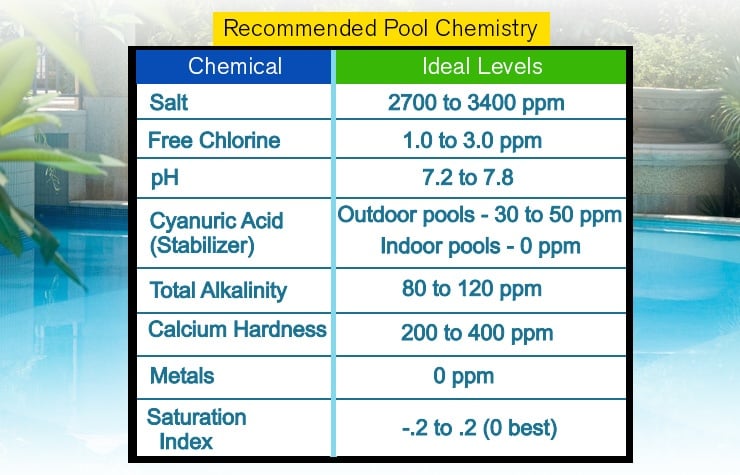
The table below lists the recommended range for each level in a residential swimming pool. Test your water, compare each result against its range, and adjust anything that falls outside it.
Two notes before you read it
- The salt row applies to saltwater pools only. If your pool uses a salt chlorine generator, keep salt in range. If you sanitize with chlorine you add yourself, your pool does not need salt and that row does not apply to you.
- Saturation index is calculated rather than tested directly. It describes whether your water is likely to be corrosive or scale forming. Your test kit instructions or a pool store water report will usually work it out for you.
| Level | Ideal range |
|---|---|
| Salt (saltwater pools only) | 2,700 to 3,400 ppm |
| Free chlorine | 1.0 to 3.0 ppm |
| pH | 7.2 to 7.8 |
| Cyanuric acid (stabilizer) | Outdoor pools 30 to 50 ppm. Indoor pools 0 ppm |
| Total alkalinity | 80 to 120 ppm |
| Calcium hardness | 200 to 400 ppm |
| Metals | 0 ppm |
| Saturation index | -0.2 to 0.2, with 0 best |
How often should I test?
Test your water at least once each week. Checking the levels regularly helps keep your water safe and clean.
Related articles
- How often should I test my chemicals in my pool?
- How much salt do I put in my pool?
- Is the pH in my pool important?
- Why is it so important to keep my chemical levels balanced?
Still Need Help?
Didn't find the answer you were looking for? You can always contact us at support@royalswimmingpools.com or choose the category below to see our most frequently asked questions for that topic: